smokers grills
Pellet, Ceramic or Charcoal? Three Smokers Compared on Published Specs
Updated 2026-08-28 · 5 min read
The picks

Best first smoker
Weber Smokey Mountain Cooker 22"
The cheapest way into genuinely good barbecue. No electronics to fail, and it never goes out of date.
- Cooking area
- 726 sq in across two grates
- Diameter
- 22 in
- Dimensions
- 48.5 in H × 23 in W × 24 in D

Best set-and-forget
Traeger Ironwood 885
The outgoing Ironwood, and the better buy for it — more grate space than the model that replaced it, for less money.
- Temperature range
- 165–500°F
- Cooking area
- 885 sq in across two tiers
- Hopper capacity
- 20 lb
Best for high heat too
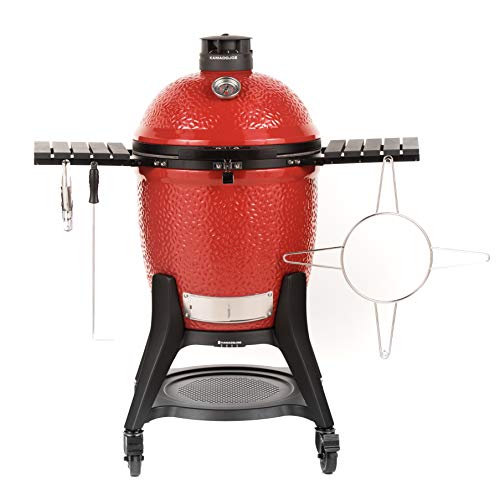
Kamado Joe Classic III
Ceramic, so it holds heat like nothing else here — and weighs what a ceramic oven weighs.
- Temperature range
- 225–750°F
- Cooking area
- 250 sq in
- Grill diameter
- 18 in
Compared
| Spec | WeberSmokey Mountain Cooker 22" | TraegerIronwood 885 | Kamado JoeClassic III |
|---|---|---|---|
| Price band | |||
| Cooking area | 726 sq in across two grates | 885 sq in across two tiers | 250 sq in |
| Diameter | 22 in | — | — |
| Dimensions | 48.5 in H × 23 in W × 24 in D | — | — |
| Warranty | 10 years on bowl, lid and centre ring | — | Limited lifetime |
| Temperature range | — | 165–500°F | 225–750°F |
| Hopper capacity | — | 20 lb | — |
| Capacity | — | 10 chickens, 7 rib racks, or 9 pork butts | — |
| Weight | — | 175 lb | 280.6 lb |
| Status | — | Listed by Traeger as a legacy model | — |
| Grill diameter | — | — | 18 in |
| Where to buy | Check current price on Amazon | Check current price on Amazon | Check current price on Amazon |
Three different machines, not three versions of one
Most smoker comparisons line up square inches and price and call it analysis. That framing fails here, because these three are not competing on the same axis. One automates the fire, one holds heat well enough to do a second job entirely, and one does neither and costs the least.
We have not cooked on any of them. What follows is what the manufacturers publish, cross-checked against each other, and what those numbers actually mean when you are standing in front of one at six in the morning.
Temperature is the real dividing line
It is the one specification that changes what the machine can do at all, rather than how pleasant it is to use.
Pellet: convenience, capped at roasting heat
Traeger publishes a 165–500°F range for the Ironwood 885. The bottom of that is genuinely useful — 165°F is low enough to hold finished food for hours — and the top is enough to roast a chicken with decent skin.
What it is not is searing heat. A pellet grill of this class will not give you a crust on a steak, and it will not bake a pizza in ninety seconds. If you expected one machine to do everything, this is where that expectation breaks.
The trade you get for that ceiling is the auger and the fan: it holds your number without you. On a cook that runs past midnight, that is worth more than a hundred degrees you were not going to use.
Ceramic: the only one here that also sears
Kamado Joe rates the Classic III at 225–750°F. That upper figure is why a kamado is often the only cooker someone owns — 750°F is searing heat, and it is inside the range where a pizza stone starts to behave.
The ceramic body is doing that work. It holds heat well enough that the fire needs very little air, which is also why a kamado sips charcoal on a long cook compared with a metal smoker.
That mass has a cost, and Kamado Joe publishes it: 280.6 lb. This is not a cooker you move, lend, or take anywhere. Decide where it lives before it arrives.
Charcoal: the one that teaches you
The Weber Smokey Mountain has no electronics at all. Nothing to update, nothing to fail in the rain, and a ten-year warranty on the bowl, lid and centre ring.
The case for it is not only price. Running a charcoal smoker means learning what the vents do, what the fire looks like when it is about to run away, and how the weather changes your day. A pellet grill hides all of that. Whether hiding it is a feature depends entirely on whether you wanted to learn.
Cooking area is arranged, not just measured
The published figures look decisive and are not:
| Cooker | Published area | How it is arranged |
|---|---|---|
| Traeger Ironwood 885 | 885 sq in | Two tiers |
| Weber Smokey Mountain | 726 sq in | Two 22-inch grates |
| Kamado Joe Classic III | 250 sq in | One 18-inch grate |
Read naively, the Kamado Joe looks like a third of the smoker. It is not. That 250 square inches is a single 18-inch circular grate, which is very close to what the geometry allows — and Kamado Joe ships a tiered system that adds surfaces above it.
The more useful question is how much of the area is one continuous surface. A brisket is a big flat object. Two stacked half-height tiers can total more square inches than a single wide grate while fitting a smaller brisket, because the limit is the longest straight run, not the sum.
Traeger's own capacity figure is the honest version of this number: 10 chickens, 7 rib racks or 9 pork butts. That tells you what fits far better than 885 does.
What the spec sheets do not tell you
Three things matter and appear nowhere in the specifications.
How long it holds temperature unattended. This is the entire argument for a pellet grill and no manufacturer quantifies it. Ceramic mass and an auger solve the same problem from opposite directions.
How much fuel a long cook costs you. Pellet consumption is roughly predictable — our calculator estimates it — but charcoal and lump vary so much with airflow, weather and how the pit is run that no honest figure exists.
Whether you will still be using it in year three. The Smokey Mountain design has barely changed in decades and nothing on it can stop working. A WiFi-enabled pellet grill has a firmware story, and the Ironwood 885 is already listed by Traeger as a legacy model.
Who each one is for
Buy the Weber Smokey Mountain if this is your first smoker, or if you want a machine that will outlive several of the others. You will spend more attention and less money, and you will understand fire better at the end of it.
Buy the Traeger Ironwood 885 if the appeal is barbecue and not fire management. It is the only one here that will hold 225°F overnight while you sleep.
Buy the Kamado Joe Classic III if it has to be the only thing in the garden. It is the only one rated high enough to sear a steak and bake a pizza as well as smoke a shoulder — and the only one you will never move again.
Common questions
- Is a pellet smoker better than charcoal?
- They solve different problems. A pellet grill holds a set temperature on its own, which matters most on a fourteen-hour cook. Charcoal costs less, has nothing electronic to fail, and many cooks prefer the flavour. If you have never smoked before, charcoal teaches you what the fire is doing.
- What temperature should you smoke at?
- Most low-and-slow cooking sits between 225°F and 275°F. Published charts put brisket and pork shoulder at roughly 1.5–2 hours per pound at 225°F, dropping to about 1–1.25 hours per pound at 275°F. Poultry is the exception and wants 275°F or higher, or the skin turns rubbery.
- How much cooking space do you actually need?
- Less than the headline number suggests. Traeger rates the Ironwood 885 at 10 chickens, 7 rib racks or 9 pork butts — far more than most households cook at once. How the space is arranged matters more than its total, because a single wide grate is more usable than the same area split across tiers.
- Can you sear on a pellet grill?
- Not on this one. Traeger publishes a 165–500°F range for the Ironwood 885, which is roasting heat rather than searing heat. The Kamado Joe Classic III is rated to 750°F, which is the practical difference between a smoker and a machine that also grills steak and bakes pizza.
Sources
Every figure on this page came from one of these. We have not tested these products ourselves — how we research.